
Vehículo adaptado versus autobús para su viaje
14 August 2026 — this needs a few corrections: the comparison should specify scheduled public buses, since private buses can also be adapted. I’ve also clarified pricing, waiting arrangements and language support while preserving the keyword and links.
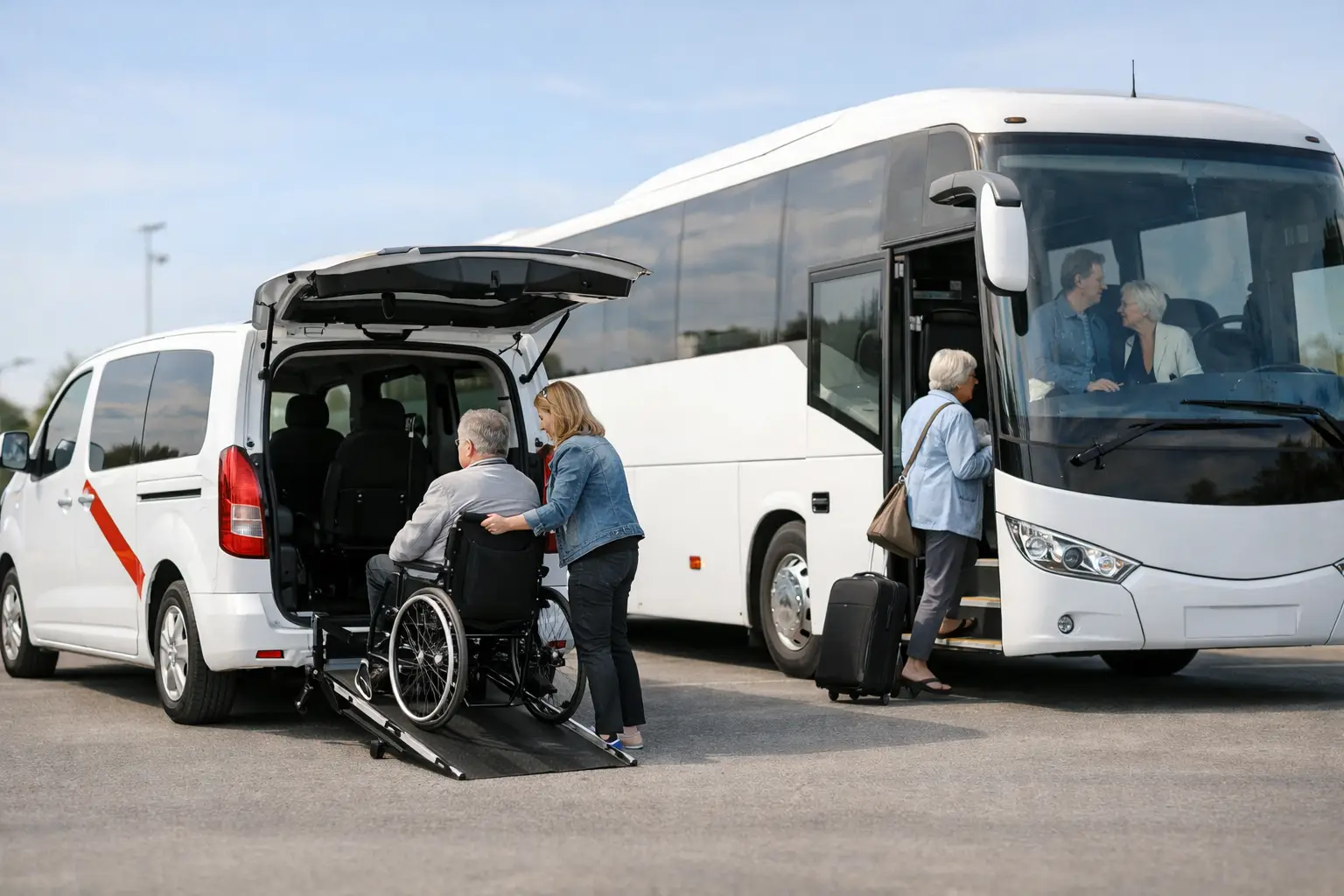
A delayed flight, several suitcases, a folding wheelchair and a hotel reservation across the city can turn a simple journey into a logistical problem. The choice of vehículo adaptado versus autobús is not simply about the fare. It affects how comfortably you travel, whether everyone can board safely, how much time you spend changing services and how confidently you can keep to your plans.
For some journeys, a scheduled public bus is a sensible and efficient option. For others, particularly airport arrivals, reduced-mobility travel, family groups and time-sensitive appointments, a private adapted vehicle can simplify the journey. The right decision depends on the passenger’s requirements and the route rather than a fixed rule.
Vehículo adaptado versus autobús: the practical difference
For this comparison, an adapted vehicle means a privately booked wheelchair-accessible car or van. A suitable vehicle has appropriate boarding equipment, wheelchair securement and occupant restraints, with sufficient interior space for the passenger. Confirm the assistance available with boarding and luggage, together with a practical pick-up point.
The bus alternative discussed here is a scheduled public service operating on a shared timetable and route. Accessibility depends on the vehicle, stops, available wheelchair space and the requirements of the passenger. Even where the bus is accessible, the journey usually includes reaching the stops, waiting and travelling with other passengers.
Private minibuses and coaches are a separate option: they can follow an agreed group itinerary, and some have wheelchair adaptations. Their suitability must be confirmed rather than assumed. The choice is therefore not simply between accessible vans and inaccessible buses.
Neither option is automatically better. A direct accessible bus can work well when the route, boarding arrangements and available space meet the traveller’s needs. A private adapted vehicle may be more convenient when direct collection, agreed assistance or a tailored schedule is important.
When an adapted vehicle is the better choice
Wheelchair access that is planned, not assumed
Accessibility is more than the presence of a ramp. A suitable vehicle needs the right dimensions, appropriate wheelchair and occupant restraint systems, and a driver who knows how to use the equipment correctly. It should also allow enough room for the passenger, accompanying travellers and required luggage.
This matters especially after a flight, before a medical appointment, or when travelling to a venue with a timed entry. A pre-booked adapted transfer allows the operator to assess the wheelchair type, dimensions and weight, whether the passenger will remain seated during travel and how many companions are joining. These details help establish suitability before the booking is confirmed.
Luggage, families and small groups
A family arriving with pushchairs, large cases and hand luggage needs to check the storage arrangements on the specific bus service. Finding room for everything can be more demanding at busy times, and keeping children, bags and travel documents together while boarding adds another consideration.
A private van may accommodate up to six passengers, depending on its approved seating configuration, luggage and wheelchair arrangement. A wheelchair position in use can reduce the number of other seats available. Larger groups can request an appropriate minibus, bus or coordinated vehicle arrangement, with accessibility assessed for the passengers who need it.
The cost should be assessed across the whole group, rather than by comparing one bus ticket with one vehicle. For several passengers, a private transfer may offer practical value once separate fares and additional local transport are considered. It should not be assumed to be cheaper without comparing the actual journey costs.
A schedule that belongs to you
Scheduled buses work to published timetables. That is useful when your itinerary aligns with them, but less helpful when a flight is late, a meeting overruns or a connection leaves little margin. A private transfer allows collection details to be agreed around your itinerary.
Confirm the meeting point, waiting allowance, whether flight monitoring is included and what happens if you are delayed. A reservation does not imply unlimited waiting or automatic availability after a substantial schedule change.
For business travel, this planning can be valuable. A quiet, climate-controlled journey creates a calmer transition between airport, hotel and meeting. It also avoids the need to navigate an unfamiliar interchange with luggage or formal clothing.
When the bus may make more sense
A scheduled bus can be the practical choice when it offers a direct route, suitable boarding arrangements and a stop close to the destination. It can suit wheelchair users as well as other passengers, provided the specific service meets their access and space requirements.
The key is to plan for the full door-to-door route, not just the time spent on the bus. Check the distance at both ends, operating hours, luggage arrangements and whether the route requires changes. If you use a wheelchair or have reduced mobility, confirm access at your chosen stops and any relevant wheelchair-space or booking conditions.
A bus journey may still involve a taxi or accessible local transfer for the final stretch. In that case, compare the complete arrangement with one direct adapted journey, taking account of transfers, waiting and luggage handling.
Comfort and privacy on longer journeys
The difference becomes more noticeable beyond the city centre. A day trip to Toledo, Segovia, Valladolid or another destination in central Spain involves more time in transit, and personal comfort begins to carry greater weight.
On a scheduled bus, you follow the route, stopping pattern and timetable set for the service. On a private journey, you can agree pick-up and return times, planned stops and waiting arrangements. Confirm space for coats, shopping, mobility equipment and day bags rather than assuming that the passenger capacity also guarantees luggage capacity.
For international visitors, clear communication can be just as valuable as physical comfort. If you are unfamiliar with Spanish transport systems, having arrangements confirmed in advance reduces uncertainty. Madrid Mobility Group can arrange English- or Arabic-speaking drivers and translator accompaniment, including Mandarin, by prior request and subject to confirmation and availability. Explain whether you need communication during the journey or accompaniment at hotels, restaurants, property viewings or events.
Pricing: compare the complete journey
A scheduled bus ticket will often have a lower headline price than a private vehicle booking. The complete comparison should include the number of passengers, local connections, luggage needs, time of arrival and any assistance arrangements.
For licensed taxi journeys, confirm the applicable regulated fare, including whether the journey uses a meter or an applicable fixed tariff. For other private transport services, request a quotation based on the route, vehicle and agreed service. Pre-booking, a day-trip itinerary or an accessibility request does not by itself determine the pricing model.
Compare services with a clear understanding of what is included. Confirm collection arrangements, luggage assistance, waiting allowances, stops and any potential additional charges. Vehicle suitability and appropriate wheelchair securement should be established as part of planning the journey, without assuming that an accessibility request automatically attracts a supplement.
Questions to ask before booking an adapted transfer
A short conversation before travel helps establish whether the vehicle matches the journey. Confirm the exact pick-up location and time, including your flight or train details where relevant. Explain the number of passengers, the quantity and size of luggage, and whether you are carrying a wheelchair, mobility scooter, pushchair or other equipment.
For wheelchair users, share the chair type, dimensions and weight, whether the passenger travels seated in it, and any transfer or assistance requirements. Ask what support the driver can provide; personal care or manual lifting should not be assumed. If there are steps at the destination, a difficult hotel entrance or restricted vehicle access, mention these so the collection and drop-off arrangements can be assessed.
It is also sensible to confirm payment arrangements, waiting conditions and the contact method for arrival-day updates. Direct WhatsApp communication can be useful if a flight is delayed or you need to request a change to the meeting point.
Madrid Mobility Group can assess private adapted transfers, group transport and longer journeys across Spain around the passenger’s requirements. Vehicle configuration, companion seating, luggage space and assistance are confirmed according to the journey and availability.
Choose the journey with fewer obstacles
The best transport option is the one that fits the real conditions of your day. A direct scheduled bus with suitable accessibility can be entirely appropriate. A private adapted vehicle may be more convenient when you need tailored collection, confirmed wheelchair accommodation, space for companions and luggage, or an itinerary with several stops.
Before deciding, picture every stage from terminal or doorstep to final destination. Compare the practical access, timing, assistance and total cost. The arrangement that reduces unnecessary transfers and uncertainty is often the one that makes the journey more comfortable.