
Madrid Seville Journey Guide for Smart Travel
Leaving Madrid’s broad boulevards for Seville’s sunlit lanes is one of Spain’s most rewarding inter-city journeys, but the right way to travel depends less on distance than on your schedule, luggage, party size and plans en route. This Madrid Seville journey guide sets out the practical differences between high-speed rail, self-driving and a pre-booked private road journey, so you can choose with clarity.
The two cities are well connected, yet each option creates a different travel day. A couple travelling light for a weekend may value the speed of rail. A family with several cases, a business party, or visitors building Córdoba into their itinerary may find door-to-door road transport more comfortable and easier to manage.
Madrid Seville journey guide: start with your itinerary
Before comparing fares, decide whether Seville is your first stop or part of a wider route through southern Spain. This is the question that often changes the best transport choice.
The direct road distance is roughly 530 kilometres. A non-stop drive commonly takes around five and a half to six hours, subject to traffic, rest breaks and the collection and drop-off points. By contrast, high-speed trains usually cover the Madrid to Seville route in approximately two and a half to three hours, although the full door-to-door journey can be longer once transfers, station arrival time and hotel check-in are included.
If you are arriving into Madrid from an international flight, allow for immigration, baggage collection and the transfer from the airport before committing to a tightly timed rail departure. The same applies on the return: a train may be fast between stations, but it does not remove the need to get from your Seville accommodation to the station, then from Madrid station to your final address or airport terminal.
A private journey is particularly worth considering when your timetable is fixed, when several people are sharing the travel day, or when you need to make planned stops. It replaces several separate bookings with one coordinated departure from your hotel, residence, office or another agreed collection point.
Taking the high-speed train from Madrid to Seville
For independent travellers with light luggage and a straightforward city-to-city plan, rail is often the most time-efficient option. Services typically operate between Madrid’s Puerta de Atocha area and Seville Santa Justa, both of which have onward taxi and local transport connections.
The principal advantage is simple: you avoid the road mileage and arrive close to central Seville. It can also be a sensible option for one or two travellers who have booked accommodation near the station or are happy to arrange transfers at either end.
There are trade-offs. Train prices can vary considerably according to departure time, demand and how far ahead you book. You will also need to handle cases through stations and be ready for boarding procedures. For families with pushchairs, travellers carrying equipment, or guests arriving after a long-haul flight, the practical effort can outweigh the shorter rail journey time.
It is sensible to choose a departure with breathing room rather than the closest connection after a flight. A delayed arrival, slow baggage delivery or simply needing time for refreshments should not turn the first day of your Spanish itinerary into a rush.
Station transfers still matter
A station-to-hotel transfer may only take a short time on a map, but the experience varies with heat, rain, luggage and local traffic. Pre-arranged transport can be useful if you are travelling with children, have a late arrival, or want a driver to meet you at a defined point and take you directly to your accommodation.
For larger parties, arrange onward transport before booking the train. This helps ensure that the vehicle type, luggage space and any mobility requirements have been considered rather than left to chance at the station.
Driving yourself: flexibility with responsibilities
Hiring a car gives you freedom to leave at your preferred time and make detours, perhaps for Córdoba, a countryside lunch or an overnight stop. The main route is generally direct, and the drive can work well for travellers who enjoy being behind the wheel and are comfortable navigating unfamiliar roads.
However, self-driving involves more than collecting a vehicle. Consider rental collection and return time, fuel, tolls where applicable, parking arrangements at your Seville hotel, local driving restrictions and the need for one person to remain focused on the road. Central areas in historic cities can have narrow streets and access rules that make a car less convenient once you arrive.
It may be the right choice for a multi-day itinerary where you will use the car repeatedly after Seville. For a one-way city transfer, especially with a group, a private driver can be more straightforward. Everyone can travel together, use the journey to rest or work, and arrive without the separate tasks of returning a hire car or finding parking.
When a private Madrid to Seville transfer makes sense
A pre-booked road journey is designed around the day rather than a station timetable. Collection can be arranged from an address in Madrid and the final drop-off can be at a hotel, private residence, meeting venue or another suitable location in Seville. This is valuable where time, privacy and luggage handling are priorities.
It is not automatically the right answer for every traveller. For a solo traveller with a small bag and a flexible schedule, rail may be the more economical and faster choice. Private transport becomes more compelling as party size, luggage volume, special requirements and itinerary complexity increase.
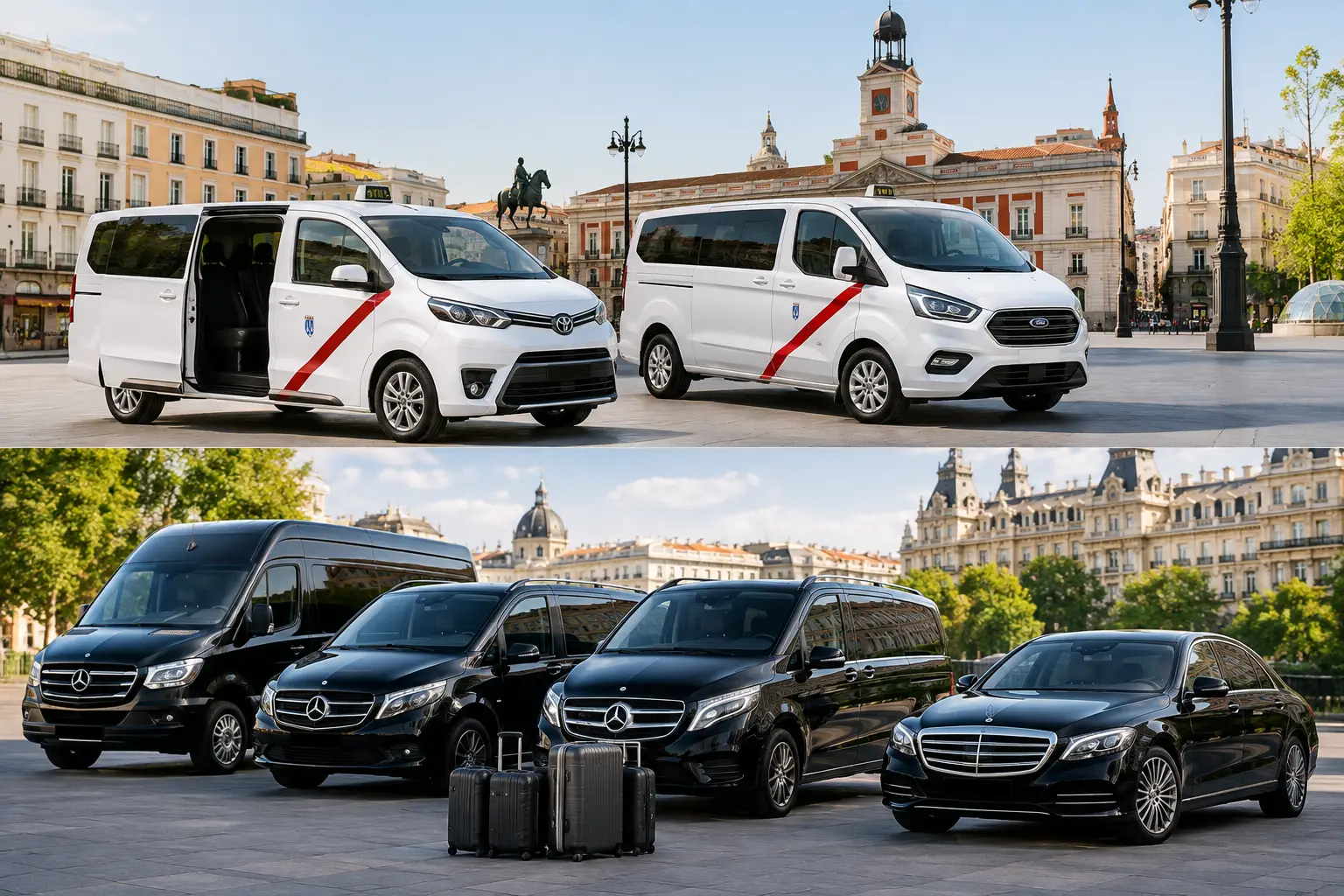
Vehicle selection should be based on the number of passengers, the size and quantity of luggage, and the nature of the journey. A modern, climate-controlled passenger van may suit a family or small group, while executive and premium vehicle options can suit business travel or guests who prefer a more refined setting. For larger groups, a larger vehicle, minibus or bus may be arranged subject to availability and the route requirements.
Pricing for a pre-booked long-distance journey should be confirmed in advance according to the vehicle, route, collection time, number of stops and passenger needs. Ask whether waiting time, planned detours or an overnight driver arrangement, if required, form part of the quote. Clear arrangements are especially useful when a group is coordinating from different locations.
Madrid Mobility Group can coordinate private long-distance journeys from Madrid to Seville and other destinations across Spain, matching the vehicle and schedule to the party rather than applying a one-size-fits-all approach.
Add Córdoba only if you have time to enjoy it
Córdoba lies naturally between Madrid and Seville and is an appealing stop for visitors interested in the Mezquita-Catedral, the Jewish Quarter and Andalusian food. It can turn a transfer day into part of the holiday, but it should be planned realistically.
A brief stop for photographs is very different from a proper visit. For time inside the historic centre, lunch and a relaxed walk, allow several hours in addition to the road journey. Confirm the desired stop duration when requesting a private quote, particularly if luggage will remain in the vehicle or you need a specific collection point afterwards.
Luggage, children and accessibility requirements
These details are best discussed before travel, not on the morning of departure. Tell your transport provider how many large cases, cabin bags, pushchairs, folding wheelchairs or items of equipment you will bring. Passenger numbers alone do not establish how much luggage space is needed.
For young children, ask about appropriate child-seat arrangements in good time. For travellers with reduced mobility or wheelchair users, explain the level of assistance and vehicle adaptation required. Adapted vehicles and suitable support should be requested in advance and remain subject to confirmation of availability. A genuine accessibility plan considers the collection point, boarding process, luggage and final drop-off, not merely the vehicle itself.
International visitors who would benefit from language support should also raise this early. Arabic, English and Mandarin translator accompaniment may be available by prior request, subject to availability, for journeys that include hospitality, property or event coordination.
A practical booking checklist
A good enquiry includes your travel date, preferred collection time, full collection and drop-off addresses, passenger total, luggage details and any planned stops. Add flight or train details where a connection is involved, but build in a sensible buffer rather than relying on a minute-perfect handover.
For business travel, clarify whether you need a quiet vehicle, multiple collections, invoicing information or schedule flexibility. For holidays and private groups, mention child seats, mobility needs, restaurant reservations or a wish to stop in Córdoba. The more accurately the journey is described, the easier it is to recommend an appropriate vehicle and provide a transparent quote.
Whether you choose rail for speed or the road for direct, flexible travel, leave enough space in the plan to arrive in Seville ready to enjoy it rather than recover from the journey.