
Accessible Travel Madrid Guide for Private Trips
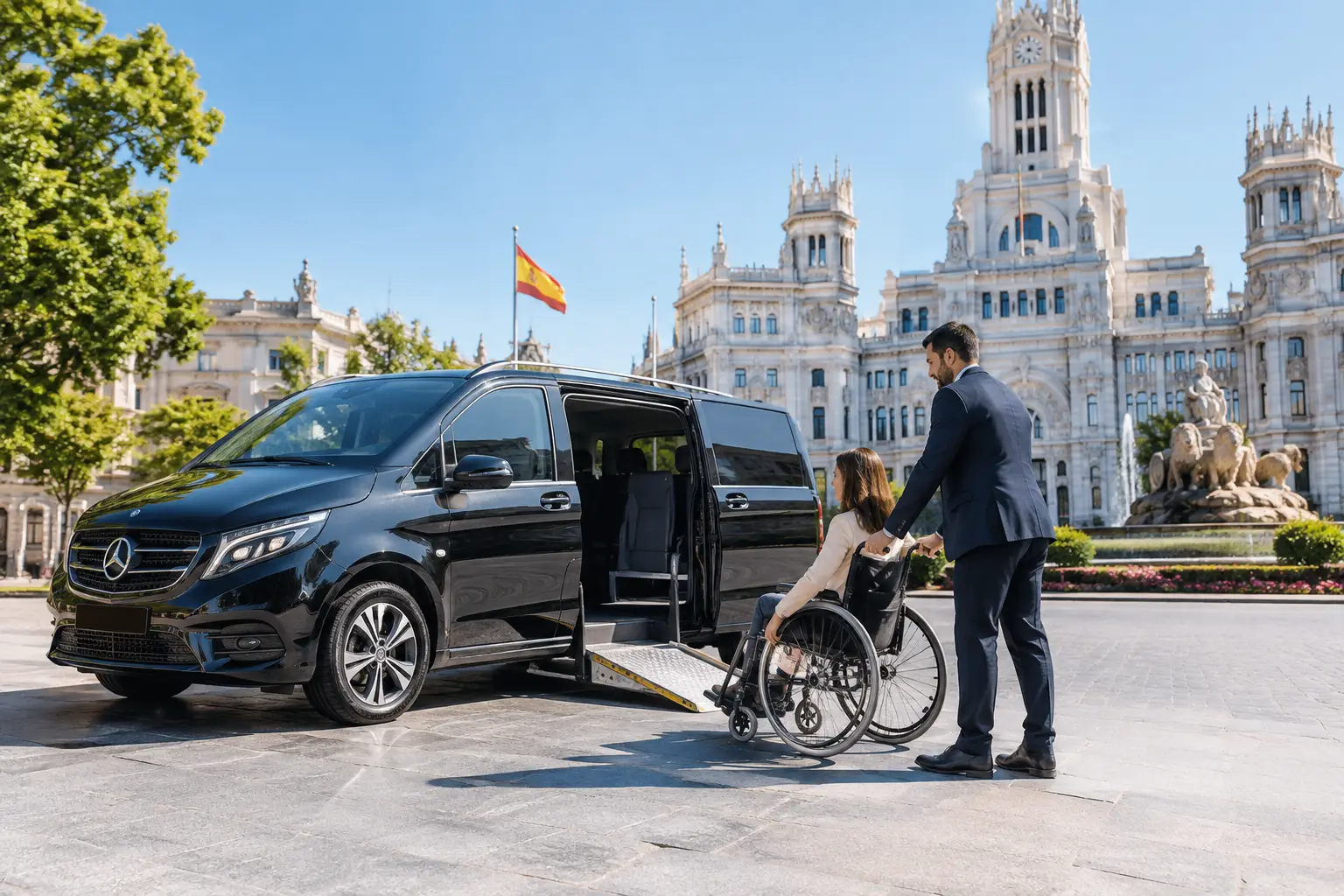
A well-planned accessible journey changes the feel of a city. Madrid has grand museums, lively neighbourhoods and wide avenues, but the details matter: the vehicle entrance, space for a wheelchair, room for luggage, the walking distance from drop-off to the door, and whether the day has been planned at a comfortable pace. This accessible travel Madrid guide focuses on those practical decisions, from arriving at the airport to arranging private journeys beyond the capital.
Accessible travel in Madrid starts before you arrive
Accessibility is not one requirement. A passenger who uses a folding wheelchair may need a different vehicle from someone travelling in a powered chair. A guest with reduced mobility may be able to transfer into a standard seat but need a low step, an armrest and help with luggage. Families may need room for a chair, pushchair, child seats and several cases at the same time.
For this reason, the most useful first step is to describe the journey rather than simply request an “accessible vehicle”. Share the passenger’s mobility needs, whether the wheelchair remains occupied during travel, its approximate dimensions and weight, the number of travellers and luggage, plus any support needed at collection and arrival. This allows the transport arrangement to be matched to the actual trip, subject to suitable vehicle availability.
Private transport can be particularly helpful after a flight or before a long onward journey because it removes the need to change between platforms, stations or kerbsides with bags. It is not automatically the right choice for every itinerary, but it offers a direct, pre-arranged option when comfort, space and assistance are priorities.
Airport transfers without unnecessary uncertainty
Madrid airport is a common starting point for visitors travelling with mobility equipment, older relatives or young children. Arrange the pickup point in advance and make sure the booking includes the airline terminal, flight details, passenger contact number and the amount of luggage. If assistance from the terminal to the vehicle is required, explain this clearly when making the enquiry so the collection arrangement can be considered properly.
Waiting allowances, parking arrangements and the pricing basis should be confirmed before travel. Licensed Madrid taxi journeys operate under regulated fare rules, while executive vehicles, adapted private transfers, vans, minibuses and longer chauffeur journeys are normally quoted according to the service and itinerary requested. Asking what is included avoids uncertainty later, particularly where a flight delay, additional stop or extended waiting period may affect the arrangement.
For a straightforward arrival into central Madrid, a suitable adapted transfer can provide space for the passenger and their equipment. For a family, corporate party or group with several wheelchairs and cases, a larger vehicle may be more appropriate. It depends on the combined requirements, not just the number of seats.
Choosing the right vehicle for your needs
An adapted vehicle should never be assumed. Confirming the right configuration in advance is essential, especially for passengers who need to remain in their wheelchair during the journey. The booking team may need details of the chair type, dimensions, whether it is manual or powered, and whether there are any items such as oxygen equipment, a hoist or medical bags that need secure space.
For travellers who can transfer from a wheelchair into a passenger seat, an executive saloon or passenger van may be suitable if the folded chair and luggage fit safely. For wheelchair users who travel seated in their chair, an adapted vehicle with the appropriate access and securement arrangement may be required. A Mercedes-Benz Sprinter, minibus or bus can be considered for larger parties, but suitability depends on the individual layout and itinerary.
This is equally relevant for executive and event travel. A conference delegation may include one guest with reduced mobility, while a wedding group may need a mix of accessible seating, luggage space and several pickup points. One coordinated plan is usually easier to manage than asking individual guests to make separate arrangements.
What to include in an accessibility enquiry
The clearest enquiries cover four areas:
- Passenger numbers, including any accompanying family members, carers or colleagues.
- Wheelchair, scooter or mobility-aid details, including whether it must travel occupied.
- Luggage, pushchairs, child seats and any equipment that needs additional space.
- The full itinerary, including airport terminal, hotels, venues, stops and onward destinations.
It is also useful to mention if an English- or Arabic-speaking driver would be helpful. Mandarin translator accompaniment can be requested for suitable journeys, subject to availability. These arrangements need to be made in advance rather than expected on the day.
Moving around Madrid at a comfortable pace
Madrid rewards a slower, well-spaced itinerary. The historic centre includes areas with uneven paving, slopes and busy pedestrian streets, while the major boulevards and modern districts can involve longer distances than they appear to on a map. Door-to-door transport can reduce the amount of walking between key stops, but it cannot remove every kerb, queue or cobbled section once you are on foot.
When planning a private day out, allow realistic time at each location and avoid treating several major sights as a race. A morning museum visit, a relaxed lunch and one afternoon destination can be far more enjoyable than trying to cross the city repeatedly. Tell your driver or coordinator if a passenger needs extra time for boarding, comfort breaks or entering venues.
For restaurants, theatres, medical appointments and meetings, provide the precise entrance rather than only the building name where possible. Large buildings may have different access points, and hotels often have a preferred vehicle collection area. A few accurate details can make arrival calmer for everyone.
Day trips near Madrid and longer Spanish journeys
Toledo, Segovia, Ávila and Valladolid can work well as private day trips from Madrid when planned around the passenger’s energy levels and the amount of walking involved. The transport can be tailored around collection times, luggage and any mobility equipment, while the route itself is planned as a realistic return journey rather than an overly packed schedule.
The destination still matters. Toledo’s historic streets, for example, can be steep and irregular, so a door-to-door vehicle arrangement should be paired with a sensible plan for time on foot. Segovia and Ávila also have historic areas where surfaces and gradients may affect how much can comfortably be covered in one day.
For Barcelona, Valencia, Alicante, Málaga, Marbella, Seville, Cádiz, Córdoba, Granada, Bilbao, San Sebastián, Santander, Asturias, Galicia or La Rioja, a long-distance private transfer or multi-day itinerary is generally more realistic than a day trip from Madrid. This can be a practical option for passengers travelling with equipment, substantial luggage or a group that would prefer direct, coordinated travel between hotels, residences, cruise connections, meetings or family occasions.
A multi-day itinerary also gives room to plan overnight stops, collection times and vehicle changes only where genuinely needed. This is particularly valuable when accessibility requirements differ between members of the party or when an itinerary combines business appointments with leisure travel.
Booking with clear arrangements
The best accessible bookings are detailed, but they do not need to be complicated. Start with the date, collection and destination, then describe the passengers, equipment and support required. If the journey includes several stops, flight arrivals, venue timings or return travel on another date, include these at the outset.
Madrid Mobility Group can coordinate licensed taxis, executive saloons, passenger vans, Sprinters, minibuses, buses and adapted transport for journeys from and to Madrid and across Spain, with the appropriate option confirmed before booking. The goal is not to offer a generic vehicle, but to arrange one that makes sense for the people, luggage and itinerary involved.
Before confirmation, check the quoted service, vehicle suitability, pickup instructions, payment terms, waiting allowances and cancellation conditions. If your plans may change, mention this early so the available options can be explained clearly. For travellers with specific assistance needs, written confirmation of the agreed arrangement offers useful reassurance.
A good accessible journey is built from small, considered details: enough space, a sensible route, clear communication and time to travel without being rushed. Share what will make the trip comfortable, and the transport plan can be shaped around the journey rather than asking the passenger to fit around it.